Measuring Arab and MENA Voters: The Civic Health & Elections Survey
The National Network for Arab American Communities (NNAAC), the Center for Arab Narratives (CAN), and Arab American Forum (AAF) have partnered with NORC at the University of Chicago. Together, we aim to deepen the nation's understanding of Arab American and Middle Eastern or North African (MENA) registered voters during this critical 2026 midterm cycle.
NORC is one of the nation’s leading nonpartisan research institutions.In the weeks leading up to the General Election on November 3, it conducted its Civic Health & Elections Survey, reaching approximately 100,000 registered voters across the United States. Our partnership with NORC allowed us to reach additional MENA voters nationwide and ask MENA voters in Michigan specific questions about their experiences with discrimination.
The results from this scientific survey were released to partner organizations on November 3 and contain one of most robust data sets available on Arab and MENA voters during the 2026 election cycle. It offers critical insights into community priorities, civic engagement, public policy concerns, and electoral participation.
Preliminary Findings
The data was only made available to project partners in the last few hours, but we were able to pull some high-level observations. Over the next few weeks and months, we will offer deeper analysis of the survey data.
Figure 1:
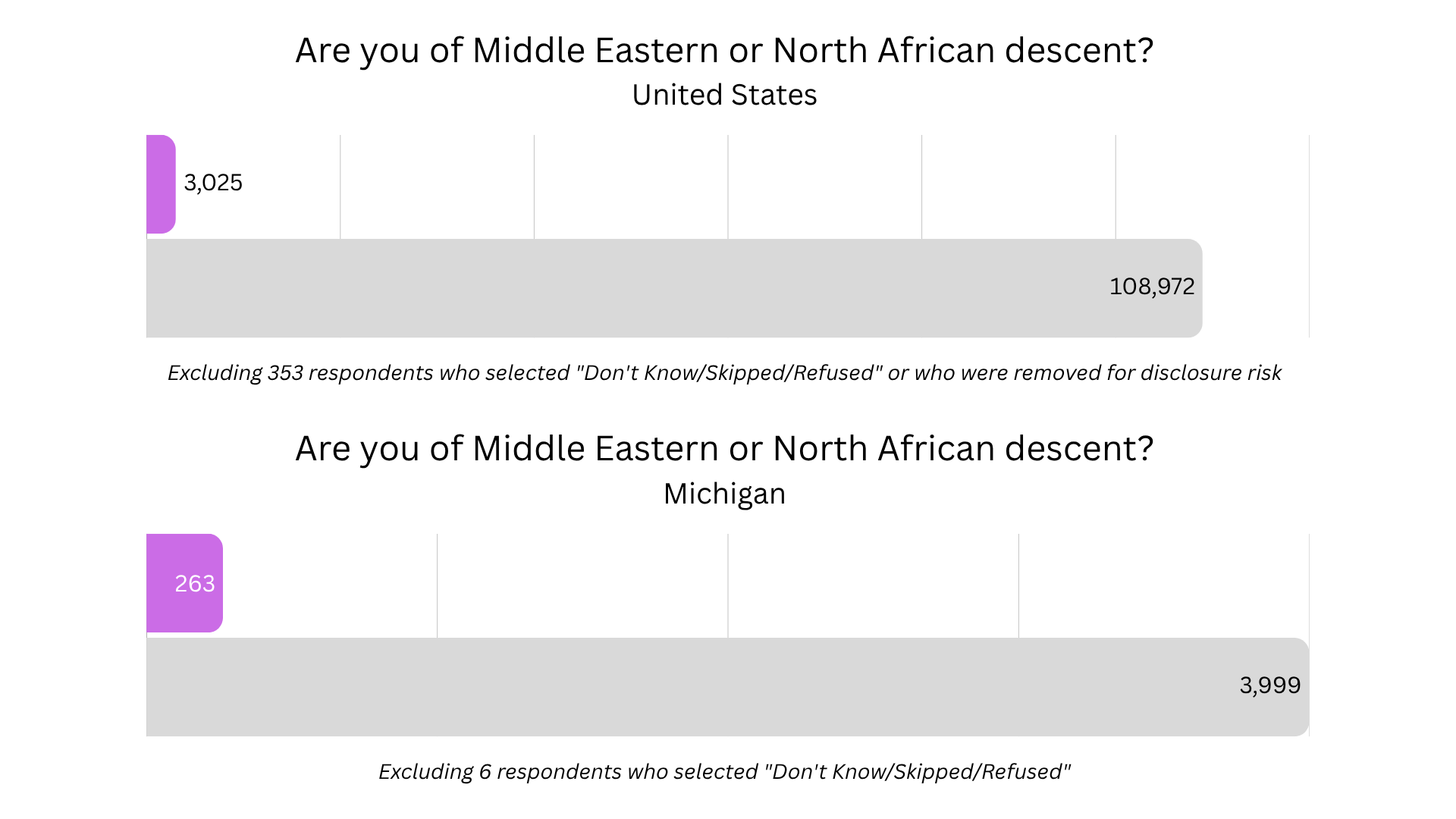
More than 3,000 registered voters nationwide identified with the Middle Eastern or North African (MENA) category. That makes the NORC survey one of the most robust data sets available on our nationwide community. Although the data is not disaggregated by heritage, such as Lebanese, Yemeni, or Egyptian, the data it does capture is rich. Age, gender, geographic location, educational attainment, among other variables, bring this large and diverse group into focus.
Figure 2:
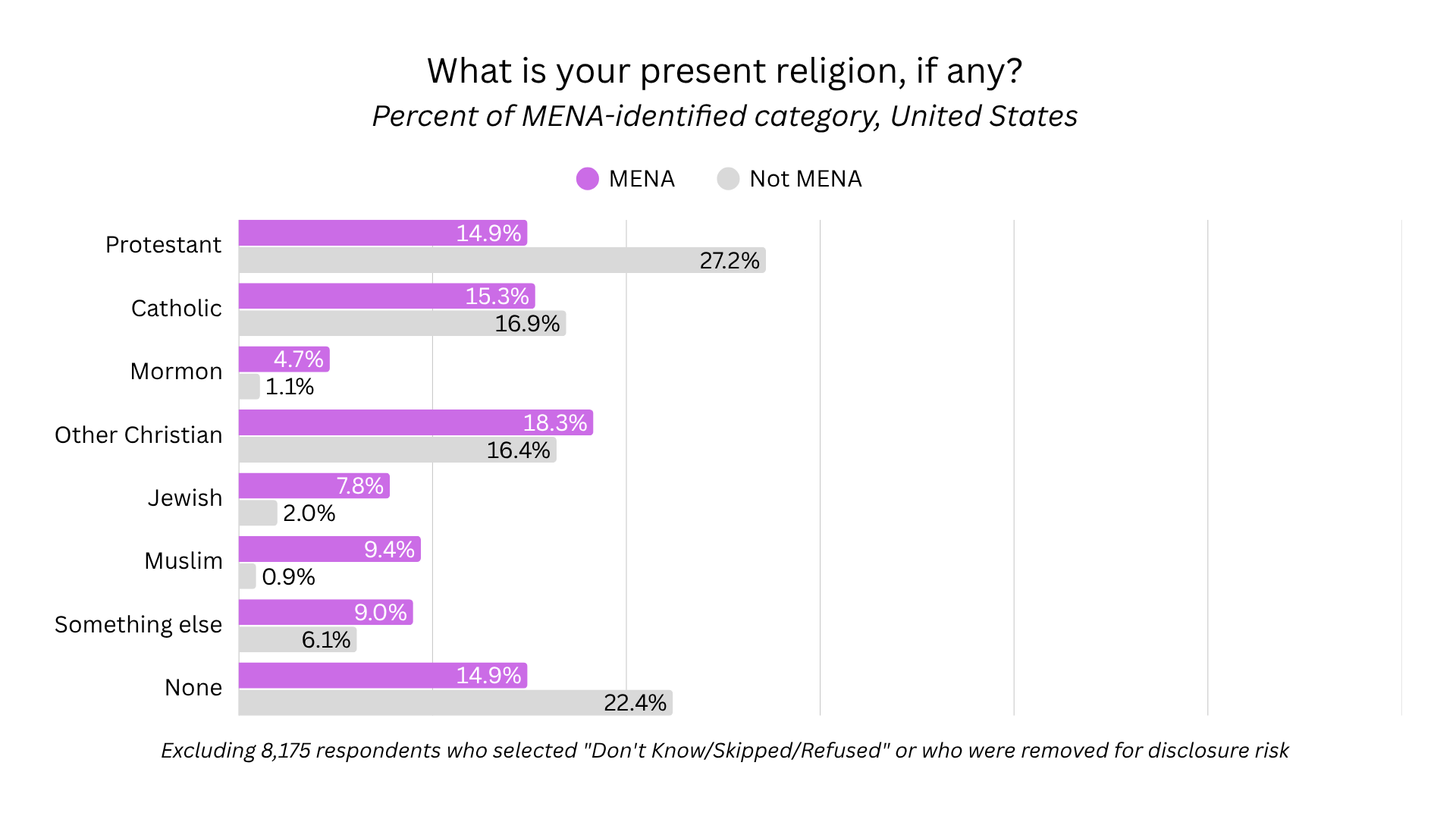
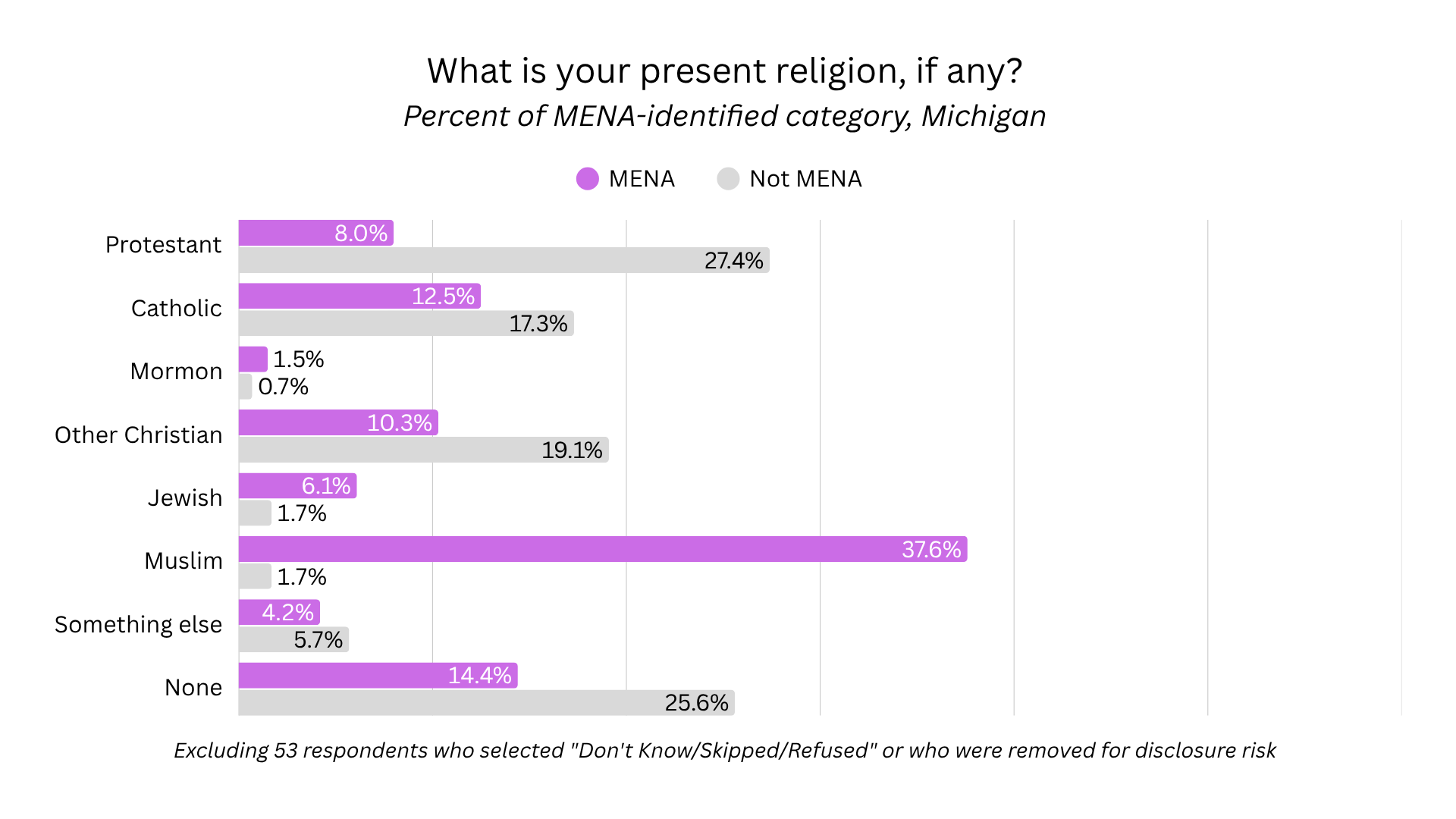
The results of this question very clearly show how diverse the nationwide MENA community is. One of the more interesting aspects is the 15% who selected “none” as their religion. Although it is a common stereotype to portray Arab Americans and other people from the MENA region as highly religious, there has always been a large secular aspect to the national community.
For the Michigan-specific data, we see a much higher percentage of Muslims than in the nationwide sample.
Figure 3:
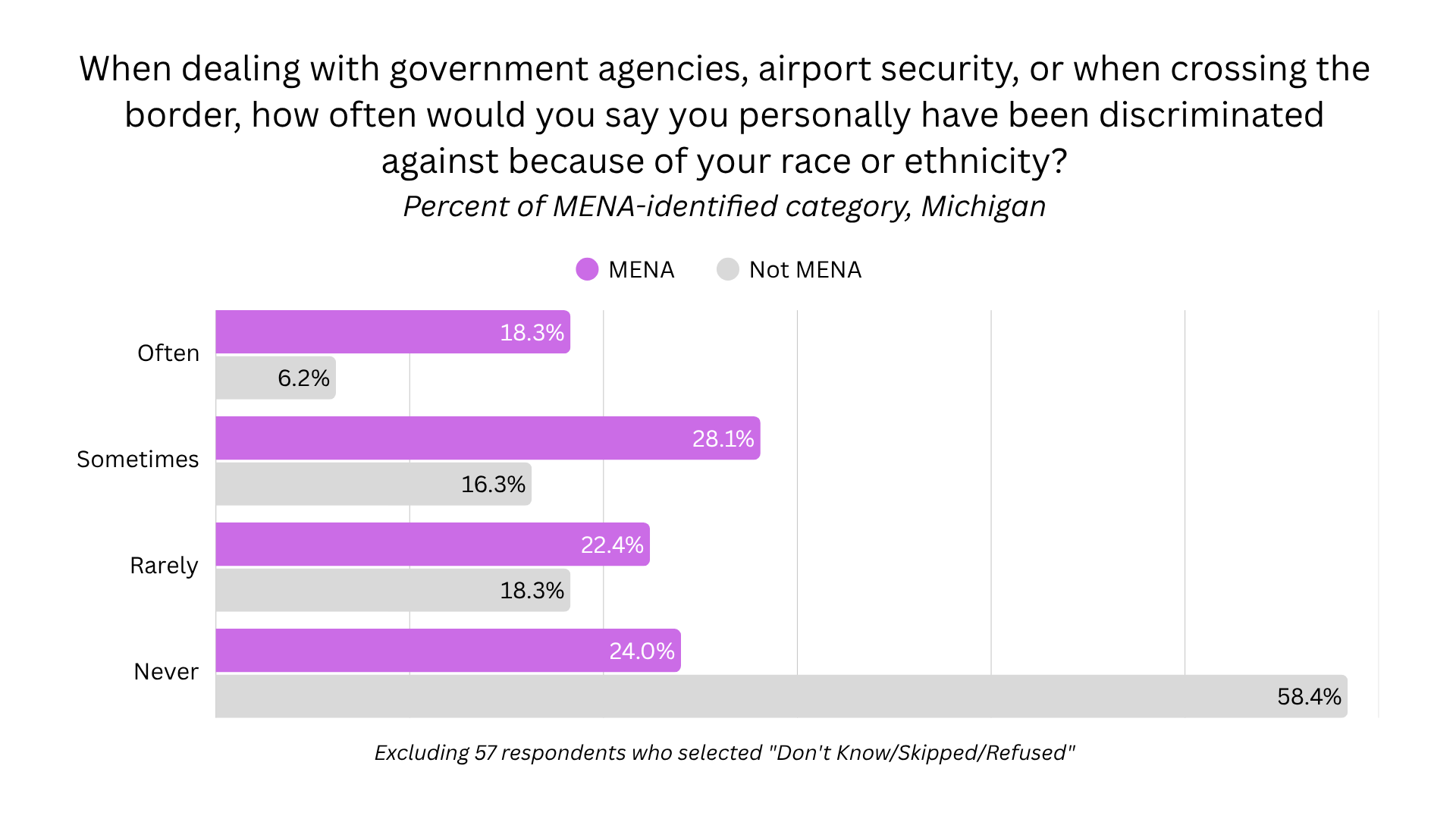
We worked with NORC to add a series of questions about community experience with discrimination in Michigan specifically. For this question, you can see a stark difference between people who identified with the MENA category in Michigan, and the general population.
The Opportunity
Arab Americans and MENA communities are among the fastest-growing and most politically relevant demographic groups in the United States. Yet they remain significantly underrepresented in national polling, election analysis, and public opinion research.
As policymakers, media organizations, researchers, and advocates seek to better understand the changing American electorate, the lack of reliable data on Arab and MENA populations limits informed decision-making and obscures the perspectives of millions of Americans.
Once we more carefully analyze the data, we will be able to:
- Measure the political attitudes and priorities of Arab and MENA voters in the lead up to the 2026 midterm elections.
- Assess how federal, state, and local policies are affecting Arab and MENA communities.
- Identify the issues most likely to influence voting behavior and civic participation.
- Understand attitudes toward policy reforms across a range of domestic and international issues.
- Generate evidence that can inform community advocacy, policy development, media reporting, and future research.
Who is NORC
NORC at the University of Chicago is an independent, nonprofit, and nonpartisan research organization widely recognized for producing some of the country's most trusted public opinion and social science research.
With more than 80 years of experience, NORC has built a reputation for methodological rigor. It has conducted the General Social Survey (GSS) for over five decades and developed the innovative methodology behind AP VoteCast, one of the nation's leading election research programs. That credibility, reach, and commitment to public access make NORC an ideal partner.
A key goal of the Civic Health & Elections Survey is to democratize access to data. Within days of the election, NORC will make findings publicly available through interactive dashboards, mapping tools, and downloadable datasets, allowing journalists, policymakers, researchers, community leaders, and advocates to conduct their own analyses of the issues, geographies, and populations most relevant to their work.
###
About NNAAC
The National Network for Arab American Communities (NNAAC), a national institution of ACCESS, is a consortium of 36 member organizations across 13 states. Established in 2004, NNAAC strengthens Arab American communities from the neighborhood to the nation by building the capacity of its member organizations, advancing policies that reflect shared values and identity, and fostering growth pathways for Arab American youth. NNAAC serves as a partner, platform, and amplifier for Arab American civic life across the United States.
About CAN
The Center for Arab Narratives (CAN), a national institution of ACCESS, exists to advance a more accurate and equitable research landscape that actively centers Arab and MENA American experiences. Established in 2015, CAN offers an interdisciplinary approach to advancing research by facilitating, spotlighting, and producing community-informed research. As the only national institution bridging the gap between academia and Arab and MENA American communities, its work begins and ends in community, turning research into stories and stories into action.
About AAF
Michigan is home to one of the largest Arab American communities in the United States. But persistent gaps in civic infrastructure limit opportunities for community members to participate in public dialogue, influence policy decisions, and build meaningful relationships across communities. To address these challenges, Arab American Forum (AAF), a 501c3 organization, will implement an integrated strategy built around three interconnected pillars:
- Black-Arab Solidarity and Community Engagement
- Strategic Communications and Public Narrative Change
- Policy Research and Leadership Development