Yalla Eat! Culinary Walking Tours as Public History
A longer form of this post appears in the chapter “Yalla Eat! Walking an Arab American Food Landscape,” in Arab American Public History, edited by Edward Curtis IV. Temple University Press: 2026. Purchase the books here: https://tupress.temple.edu/books/arab-american-public-history
The Arab American National Museum’s (AANM) Yalla (Let’s go) Eat! program consists of walking tours of Arab American commercial districts, pop-up dinners, special tasting events, an Instagram chef series, and a food map of the Dearborn, Michigan, community. The walking tour program began in 2013 and has remained a popular staple of the museum ever since.
As AANM staff began planning and executing the Yalla Eat Culinary Walking Tours, we took as our premise that (1) food was the most poignant way to engage non-Arabs in the history, culture, and experiences of Arab Americans; (2) most non-Arabs in metro Detroit have only a surface-level familiarity with the broad range of Arab and/or Middle Eastern cuisine; (3) by bringing people into direct contact with Arab American business owners and by walking through Arab American commercial districts, we could help to dispel stereotypes about Arabs and Arab Americans, especially considering all of the negative attitudes toward the mostly Muslim Arab community of Dearborn; and (4) as a community-based cultural organization, it is beneficial to take our visitors outside of the walls of the museum and allow the community to tell their own story through the lens of cultural identity and entrepreneurship.
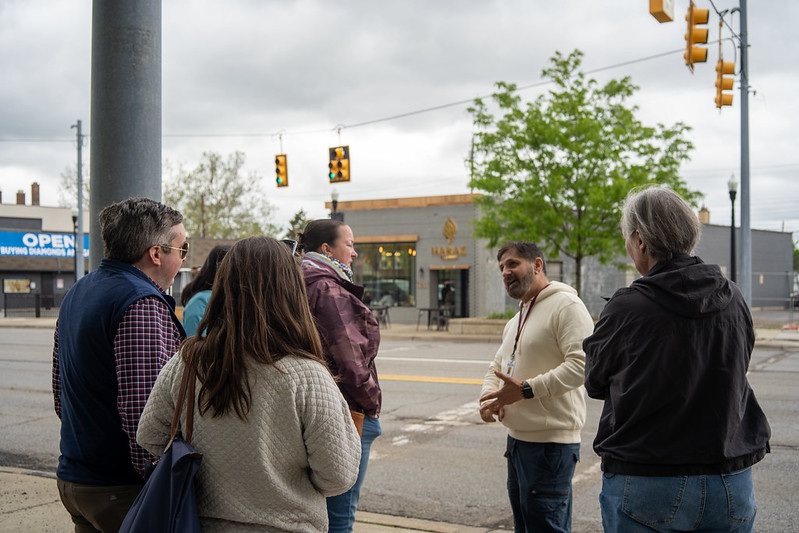
The Tour
The tour along Warren Avenue, East Dearborn’s original Arab commercial district, is the version we have run the most and has garnered the most media attention for AANM and the Yalla Eat! program. Tour guests get a strong sense of the scale of the community and its history in Dearborn. The stretch of Warren Avenue that the tour traverses (nearly a three-quarter-mile section) contains Arab American–owned businesses lining both sides of the street—dozens and dozens of them. From gas stations, to accountants, to bakeries, to doctor’s offices, almost every single business is either Arab owned or caters to the community.
The overwhelming majority of tour participants are not Arab or Arab American. Most are from the metro Detroit region, and many have experience with Arab or Middle Eastern food, though rarely beyond the few well-known restaurants in the area.
The tour typically stops at a grocery store, a spice and coffee store, a couple of bakeries and sweets shops, and at least one restaurant. For participants, this allows them to experience Arab food from the ingredients (produce, meats, and spices) through the main course and into dessert. The variation in establishments also presents different aspects of the Arab American culinary experience: from Lebanese and Palestinian to Iraqi and Yemeni.
Culinary Tourism as Public History
The overwhelming majority of tour participants are not Arab or Arab American. Most are from the metro Detroit region, and many have experience with Arab or Middle Eastern food, though rarely beyond the few well-known restaurants in the area. Most of the participants are only familiar with Levantine cuisine, widely available in metro Detroit for the last forty-plus years, and Levantine cuisine has come to stand in for all Middle Eastern or Arab food. Through our walking tours, which admittedly visit mainly Lebanese-owned establishments with an increasing number of Yemeni places, we try to situate the available Arab food in metro Detroit in a larger historical and culinary context. Most participants were not familiar with the real history of Arab Americans in the region, beyond the oft-repeated statistic of Dearborn having the highest concentration of Arab Americans in any city in the United Statesi. This was the unique aspect of the Yalla Eat! tours—the mixing of food tasting, stories about culinary tradition, and physically traversing the history of the Arab American community, all led by a community-based cultural center.
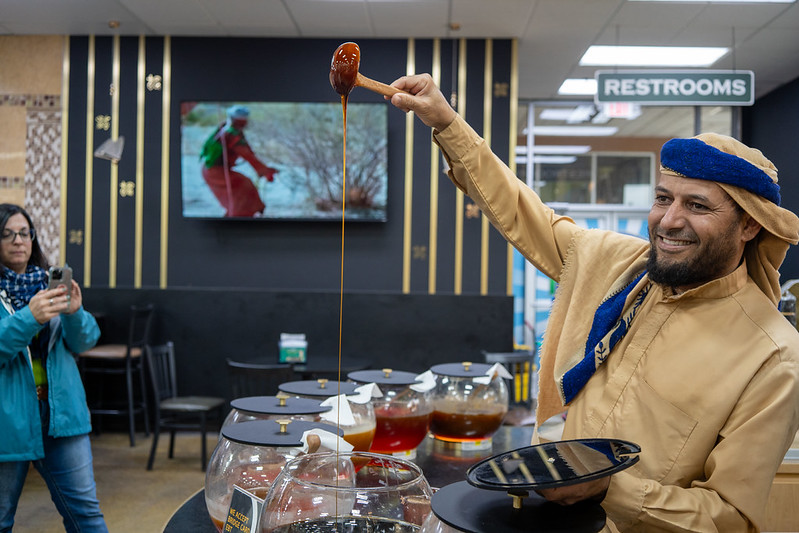
The tour typically stops at a grocery store, a spice and coffee store, a couple of bakeries and sweets shops, and at least one restaurant. For participants, this allows them to experience Arab food from the ingredients (produce, meats, and spices) through the main course and into dessert.
Even as food serves as a bridge between cultures and engages all the senses, focusing solely on the food could leave the culinary tourist with a very “thin” level of understanding of the ethnic group and its issues and experiences. Through public foodways, cultural identity is often presented through a noncritical multiculturalist lens. This is an issue that we have grappled with throughout the development of the Yalla Eat! tours—using food as an introduction to, but not the only avenue for, discussing the lived experiences of Arab Americans.
The Yalla Eat Tours actively work against the thin construction of identity. The walking tours combine food with a deeper experience of eating and purchasing ethnic food in context, conversing with actual Arab American business owners, absorbing the community’s history (although mostly scripted), and engaging with the Arab American community on its own terms for a two- to three-hour journey.
So, what makes the Yalla Eat! tours so popular? Is it the food? The chance to interact with real, live Arabs? The role of AANM? The heightened tension of exploring an Arab American enclave in a neighborhood maligned by popular and political discourse as a foreboding, un-American place? To answer my own rhetorical questions, I think the popularity comes from the unique combination of all of these factors. But ultimately, it is the food that draws people in—and usually keeps them coming back.
References:
i According to the 2020 U.S. Decennial Census, over 50 percent of Dearborn’s population of nearly 100,000 people is of Arab ancestry.